
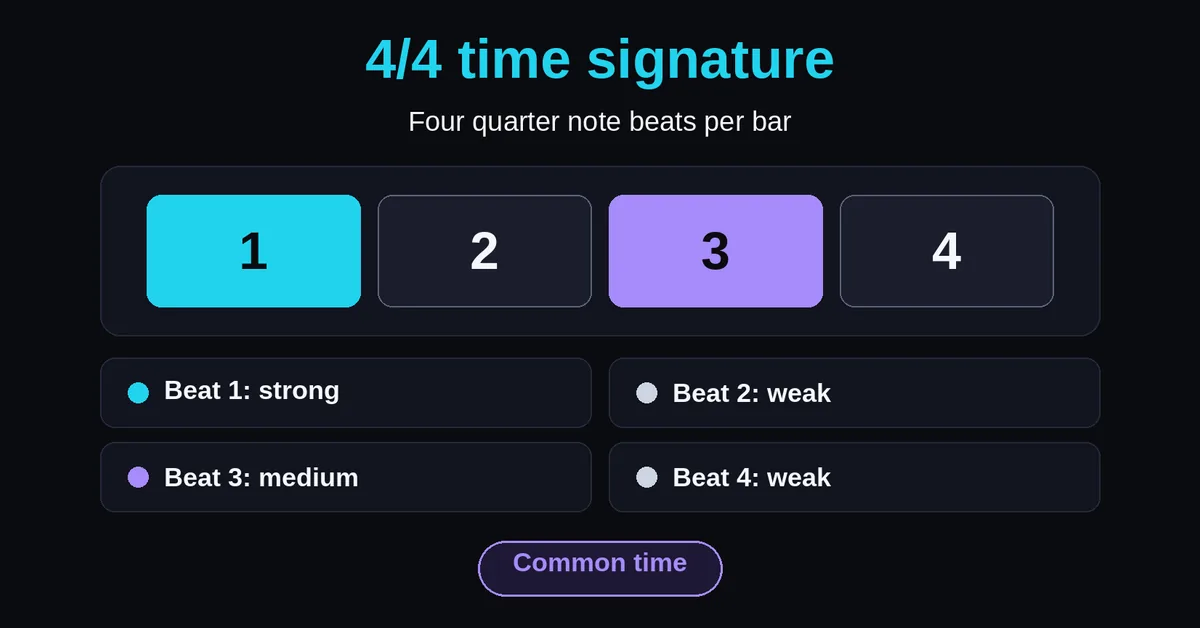
What Does 4/4 Mean in Music?
The upper 4 tells you that a complete measure contains four beats. The lower 4 identifies the quarter note as the beat unit. Musicians call this simple quadruple meter: four beats, each normally divided into two eighth notes. A bar and a measure mean the same thing.
“Simple” describes beat division, not musical difficulty. See the Open University's meter classification.
Imagine a ballad at 70 beats per minute and a punk exercise at 180 BPM: both can have four beats per bar. The tempo guide explains speed separately.
How Do You Count 4/4 Without Losing Beat 1?
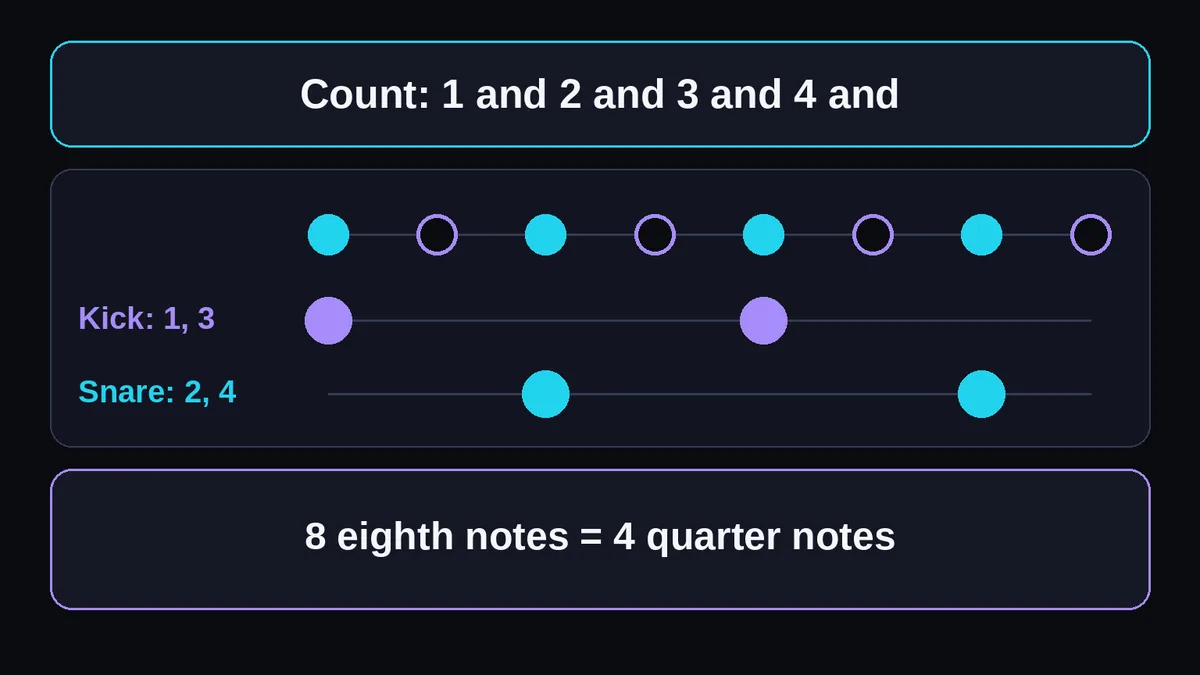
Say “1, 2, 3, 4” at equal intervals and return to 1 after 4. Make 1 your reference point, with a smaller emphasis on 3 for a basic counting exercise. Add “and” halfway between numbers for eighth notes, keeping the numbered beats at the same speed.
This is a teaching grid, not a rule requiring every performer to emphasize these positions:
| Position | Beat 1 | Beat 2 | Beat 3 | Beat 4 |
|---|---|---|---|---|
| Basic metric weight | Strong | Weak | Medium | Weak |
| Eighth note count | 1 and | 2 and | 3 and | 4 and |
| Rock or pop drum exercise | Kick | Snare | Kick | Snare |
The table assumes a quarter note beat. Open Music Theory explains the hierarchy; performed accents can differ.
For a sixteenth note passage, say “1 e and a, 2 e and a, 3 e and a, 4 e and a.” A triplet divides one beat into three equal parts, counted “1 trip let.” These are different subdivision grids, as shown in Musicnotes' counting lesson.
Practice a specific offbeat: keep saying the eighth note count, but clap only the “and” after 2. If you start calling that clap beat 1, return to clapping the numbered beats before trying again.
What Notes and Rests Fit in One Bar?
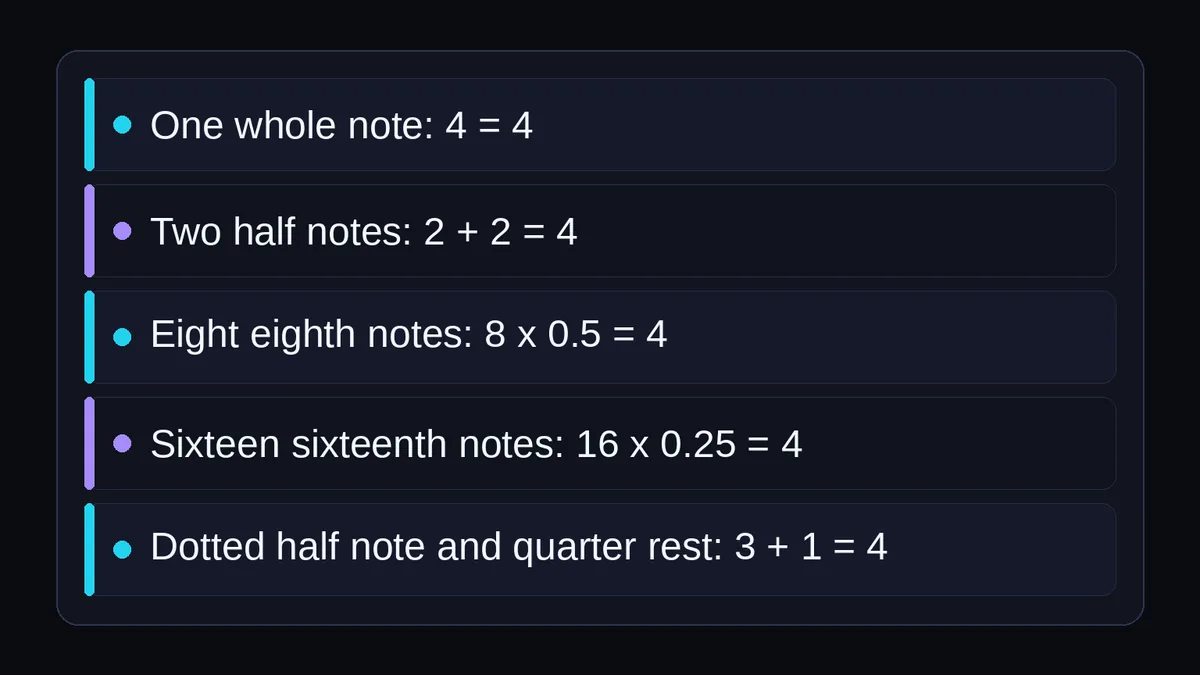
A complete bar can contain any combination of note and rest durations totaling four quarter beats. Four beats do not require four separate sounds. A held note can cross several counts, and a rest occupies time even though you play nothing. Keep counting through both sustained notes and silence.
The values below count quarter notes, which in 4/4 is also the written beat, so the number on the score goes straight into the metronome.
| Example bar | Quarter beat arithmetic | What you do |
|---|---|---|
| One whole note | 4 = 4 | Attack on 1, sustain through 4 |
| Two half notes | 2 + 2 = 4 | Attack on 1 and 3 |
| Eight eighth notes | 8 × 0.5 = 4 | Play numbers and “ands” |
| Sixteen sixteenth notes | 16 × 0.25 = 4 | Play each “1 e and a” slot |
| Dotted half note, quarter rest | 3 + 1 = 4 | Hold through 3, rest on 4 |
Musicnotes' counting examples explain counting through rests. A dotted note adds half its original duration, so a dotted half note lasts three quarter beats.
Try an original mixed bar: quarter rest, two eighth notes, then a half note. Say 1 silently, play on 2 and its “and,” then attack on 3 and hold through 4. The sum is 1 + 0.5 + 0.5 + 2 = 4 beats. Restart on the following 1, even though the final attack happened earlier.
How Does 4/4 Feel Across Different Grooves?
A four beat bar can support a straight rock pattern, swung jazz phrasing or syncopated electronic percussion. Meter organizes the underlying beats; groove changes how sounds sit around them. Walking or swaying can help you practice, but neither movement proves a time signature. Follow several bars before choosing your count.
In the drum exercise above, the snare on 2 and 4 creates a backbeat. Ableton's backbeat lesson demonstrates that placement and a house or techno variation with a kick on every quarter beat. Compare that pattern with the house tempo examples.
Compare kicks on 1 and 3 with kicks on all four beats, leaving the snare unchanged. Neither drum pattern is compulsory in 4/4.
Which Songs Can You Use to Practice 4/4?
Use the six songs below as provisional four beat counting exercises. Begin with a passage where the accompaniment repeats clearly, then follow its count across a section change. A song title alone does not establish the notation of every arrangement. Check the score for the version and section you intend to play.
| Song | Artist | Suggested counting task |
|---|---|---|
| Billie Jean | Michael Jackson | Keep the numbered count while listening to the drums |
| Sweet Child O' Mine | Guns N' Roses | Follow the accompaniment rather than counting each guitar note |
| Rolling in the Deep | Adele | Maintain the count across a vocal phrase |
| Photograph | Ed Sheeran | Compare the accompaniment with the vocal entry |
| Hotel California | Eagles | Track successive bars through a longer phrase |
| We Will Rock You | Queen | Separate percussion attacks from the underlying count |
No specific score or arrangement was supplied for these candidates; use them for listening practice rather than notation evidence.
Count a four bar exercise as “1 2 3 4, 2 2 3 4, 3 2 3 4, 4 2 3 4.” The first number tracks the bar. A phrase spanning four or eight bars can contain several returns to beat 1; counting a longer phrase does not make each bar eight beats long.
How Does 4/4 Compare With 3/4 and 6/8?
In 4/4, count four quarter beats; in 3/4, count three quarter beats. In 6/8, the six eighth notes normally form two dotted quarter beats, each containing three divisions. Listen for the repeating grouping rather than judging by speed or a single accent. Matching BPM numbers also requires matching beat units.
For a short spoken comparison, try “ONE two Three four,” then “ONE two three,” then “ONE and a TWO and a.” The Open University lesson explains these simple quadruple, simple triple and compound duple groupings.
Many waltzes use 3/4 and many jigs use 6/8. Those associations are listening clues, not substitutes for checking an arrangement. Use the time signatures and BPM hub for the broader comparison, or the 6/8 versus 3/4 explanation for that pair.
How Long Is a Bar of 4/4 at Different Tempos?
A bar lasts four quarter note intervals, so its duration in seconds is 240 divided by the quarter note BPM. At 120 BPM, each beat lasts 500 milliseconds and a bar lasts 2 seconds. Count the interval through the next bar's beat 1, rather than stopping at beat 4.
| Quarter note tempo | Beat duration | Bar duration | Bars per minute |
|---|---|---|---|
| 60 BPM | 1,000 ms | 4 seconds | 15 |
| 90 BPM | About 666.67 ms | About 2.67 seconds | 22.5 |
| 120 BPM | 500 ms | 2 seconds | 30 |
At 120 BPM, beat onsets occur at 0, 500, 1,000 and 1,500 ms; the next bar starts at 2,000 ms. Ending a loop at the fourth onset cuts off its final beat interval. In Ableton Live, use the loop start and length controls described in its Arrangement manual to select a complete bar. Calculate another tempo with BPM to milliseconds.
How Do You Practice 4/4 on a Metronome?
Set the online metronome to 4/4, choose 60 BPM and select the normal quarter note subdivision. Enable the first beat accent so each bar begins with a clear reference. Count aloud before playing. Add subdivisions only when you need help placing notes between beats, then return to the quarter clicks.
Try this sequence on the free online metronome:
- Count four bars without playing, finding the accented 1 each time.
- Play four bars of quarter notes on a guitar, piano or practice pad.
- Play four bars of eighth notes. Use eighth subdivisions to check rushed offbeats in funk or hip hop patterns.
- Repeat the mixed rest and half note bar above four times, keeping the count during silence.
The tool accents beat 1 only. Supply the smaller beat 3 emphasis yourself. For tempo building, choose a target, begin 10 BPM below it and set the speed trainer to add 2 BPM every 8 bars. Reaching the target requires five increases; lower the starting tempo if the rhythm breaks down.
To match a recording, use tap tempo first, then enter that reading into the metronome. Tap the quarter pulse rather than every percussion hit.