

What Does the 6/8 Time Signature Mean?
The top number says there are six units in each bar, and the bottom number says each unit is an eighth note. Read literally, that is six eighth notes per bar. In practice, those six notes are almost always heard as two groups of three, which turns six small pulses into two large beats.
That grouping is what makes 6/8 compound. In a compound meter each beat divides into three equal parts, and the beat itself is a dotted note: a dotted quarter, worth three eighth notes. Duple means two beats per bar. Put together, compound duple describes 6/8 exactly.
Wikipedia's time signature article notes that 6/8 is most often felt as two beats, each a dotted quarter. Its examples table lists jigs, tarantellas, barcarolles, marches, polkas and some rock music, a wide spread that shows how flexible the meter is.
How Do You Count 6/8 Time?
The simplest count is "1 2 3 4 5 6," with a strong accent on 1 and a lighter one on 4. Once that is steady, switch to a two beat count such as "1 la li 2 la li" or "1 and a 2 and a," which keeps the two main beats clear.
| Counting method | One bar spoken | Best for |
|---|---|---|
| Six count | ONE two three FOUR five six | Slow music and beginners |
| Syllable count | 1 la li 2 la li | Hearing two beats while keeping all six notes |
| And a count | 1 and a 2 and a | Players used to 4/4 counting |
| Two count | 1 . . 2 . . | Fast music, felt in two |
Practice the shift between them. Clap all six eighth notes while saying the six count for two bars, then keep clapping but say only "1" and "2" for two bars. The notes do not change; only the level of pulse you attend to does. That switch is the core skill of 6/8.
Is 6/8 Two Beats or Six?
Both, depending on tempo. At slow speeds, players often feel all six eighth notes as beats. At moderate and fast speeds, 6/8 is felt in two, with the eighth notes acting as subdivisions. Conductors follow the same rule: a slow 6/8 may be beaten in six, a faster one in two.
A rough rule of thumb helps. When the eighth notes move faster than about two per second, counting all six becomes tiring and the music starts to feel like two big beats. Slow lullabies and some ballads sit below that point; jigs and marches sit well above it.
This matters for tempo numbers too. "Two beats or six" is really a question of which note value the BPM counts, and that is where most 6/8 confusion begins.

How Do You Read a BPM in 6/8?
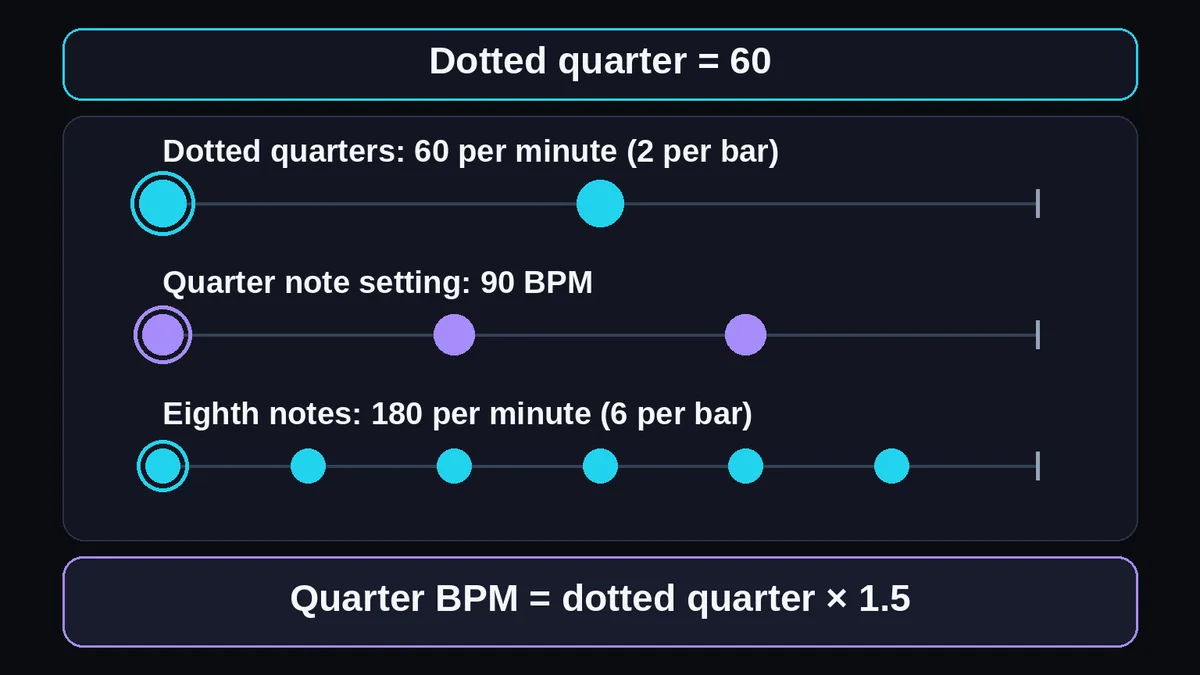
In 6/8 a metronome mark usually counts dotted quarter notes, the main beat. To convert it for a metronome that counts quarter notes, multiply by 1.5. To find how many eighth notes pass per minute, multiply the dotted quarter number by 3. A dotted quarter of 60 equals 90 quarter notes or 180 eighth notes per minute.
| Dotted quarter pulse | Quarter note setting | Eighth notes per minute | One bar of 6/8 |
|---|---|---|---|
| 40 | 60 BPM | 120 | 3.00 s |
| 60 | 90 BPM | 180 | 2.00 s |
| 80 | 120 BPM | 240 | 1.50 s |
| 100 | 150 BPM | 300 | 1.20 s |
| 120 | 180 BPM | 360 | 1.00 s |
Song databases and tap tempo tools can report any of these three numbers for the same track. A song felt at 60 dotted quarters might appear as 60, 90 or 180 BPM, depending on what was counted. If a reading looks too fast, divide by 3 or by 1.5 and see which matches the beat you feel. The half time and double time guide covers similar factor errors in 4/4 music.
Why Does 6/8 Sound Like a Jig or a Rocking Boat?
The three note groups create a swinging, rolling motion: long, short, short, then again. That shape suits dances and songs about movement. Irish and Scottish double jigs, the Italian tarantella and the barcarolle, a Venetian boat song, all rely on 6/8 for that rocking lilt.
Marches use 6/8 differently. At a brisk tempo, two strong beats per bar match two marching steps, while the triplet subdivision adds a skipping spring. John Philip Sousa's The Washington Post march is a well known example of 6/8 march style.
Ballads and slow rock songs use 6/8 for a gentle sway. At a relaxed tempo, the three eighths inside each beat feel like a soft rocking, which is why many lullabies sit naturally in 6/8. The same meter can sound playful, stately or tender depending on speed and accent.
Which Songs and Pieces Are in 6/8?
Documented examples include The Animals' "The House of the Rising Sun," Grieg's Morning Mood, and Billy Joel's "Piano Man." Each source states the meter directly, which matters because many song lists online disagree. When in doubt, check a published score rather than a list.
- The Animals, "The House of the Rising Sun" (1964). Wikipedia notes that the Animals version was played in 6/8, unlike the 4/4 of most earlier versions. The arpeggiated guitar spells out the three note groups clearly.
- Edvard Grieg, Morning Mood from Peer Gynt. Wikipedia gives the time signature as 6/8 and the tempo instruction as Allegretto pastorale. The flute melody rocks gently over the two beat pulse.
- Billy Joel, "Piano Man" (1973). Often filed as 3/4, but its Wikipedia article describes it as being in 6/8 with a fast waltz feel. A good test of whether you hear two beats per bar or three. Strictly, waltz time means 3/4; the word is used loosely for this song.
- Mozart, Symphony No. 40, second movement (Andante). A slow movement in 6/8, useful for hearing the meter at a calm tempo. See the Andante tempo guide for the marking.
- John Philip Sousa, The Washington Post march. A classic 6/8 march with a strong two step pulse.
How Does 6/8 Differ From 3/4 and 12/8?
6/8 and 3/4 both hold six eighth notes per bar, but 6/8 groups them as two beats of three while 3/4 groups them as three beats of two. 12/8 simply doubles 6/8: four dotted quarter beats per bar instead of two. The beat unit and the grouping are what change.
| Meter | Beats per bar | Beat unit | Each beat divides into | Type |
|---|---|---|---|---|
| 6/8 | 2 | Dotted quarter | 3 eighth notes | Compound duple |
| 3/4 | 3 | Quarter | 2 eighth notes | Simple triple |
| 12/8 | 4 | Dotted quarter | 3 eighth notes | Compound quadruple |
| 2/4 | 2 | Quarter | 2 eighth notes | Simple duple |
For side by side listening tests, beaming rules and matched timing, see 6/8 vs 3/4. For 2/4, the simple duple cousin of 6/8, see the 2/4 time signature guide.
How Do You Set a Metronome for 6/8?
Choose 6/8 in the online metronome and enter the quarter note equivalent of your dotted quarter pulse. In this metronome's x/8 modes, the BPM counts quarter notes and every eighth note clicks, with the accent on the first click of the bar. For a dotted quarter of 60, set 90 BPM.
- Decide the dotted quarter pulse you want, or read it from the score.
- Multiply by 1.5 and enter the result as BPM. A dotted quarter of 80 becomes 120 BPM.
- Select 6/8. You will hear six eighth note clicks per bar, with the first one accented.
- Count "1 la li 2 la li" with the clicks. Notice that the accent marks only beat 1, so listen for beat 4 yourself.
- For slow ballads, start around a dotted quarter of 40 to 50 (60 to 75 BPM). For jigs and marches, work up toward a dotted quarter of 100 or more (150 BPM and above).
The metronome covers 20 to 360 BPM, which spans dotted quarter pulses from about 13 to 240. Its speed trainer can raise the tempo a few BPM every set number of bars. To check a 6/8 recording, tap the dotted quarter beat on the tap tempo tool with the spacebar, a letter or a number key, then multiply by 1.5 if you want the quarter note setting.