
What Is a Polyrhythm?
A polyrhythm combines rhythmic layers whose divisions pull against each other. The examples here use evenly spaced attacks across a shared cycle: three notes against two, four against three, and other ratios. Those numbers describe how the layers fit together. They do not tell you the tempo or time signature.
Jonathan Curtis's percussion lecture explains the relationship through simultaneous pulse groups. Throughout this guide, A:B means A overlay attacks against B reference attacks per cycle. Authors and tools can reverse those roles, so identify the reference before setting beats per minute.
A triplet played alone demonstrates a division. Put three equal notes against a simultaneous two note layer and the 3:2 relationship becomes explicit. In compound meter such as 12/8, three eighths already divide each dotted quarter beat. Add two evenly spaced notes across that same beat for the contrasting division.

How Do You Count 3 Against 2?
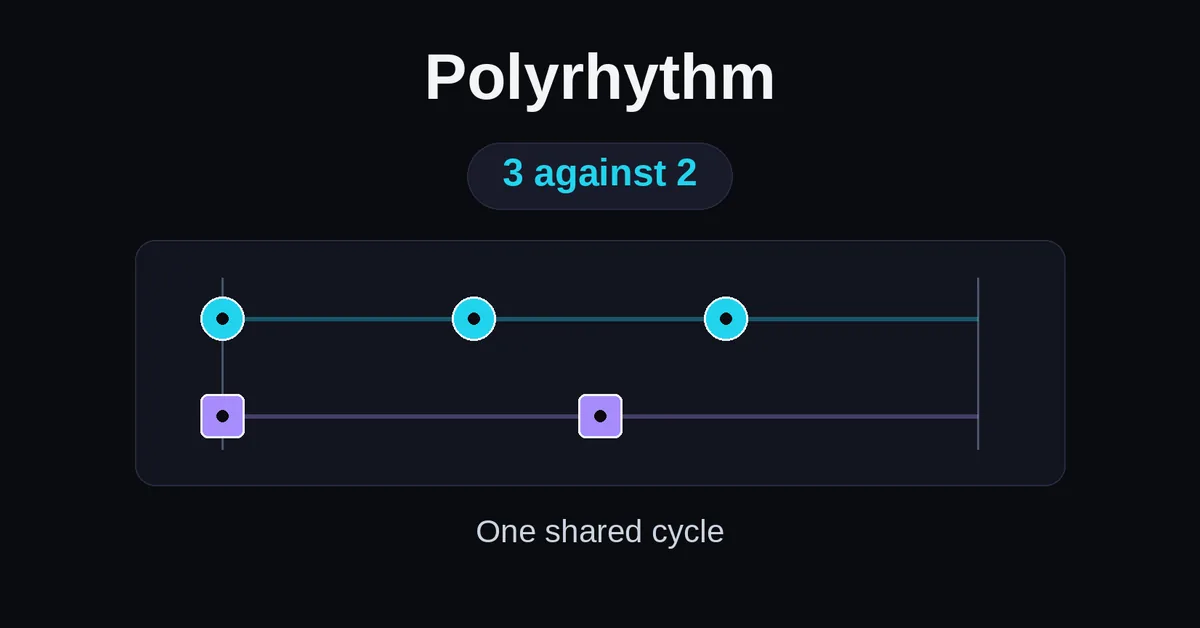
Count six equal slots. Play the three note layer on spoken counts 1, 3 and 5, and the two note layer on 1 and 4. Both hands strike on 1. Count through 6 before returning to 1; that final empty slot is part of the rhythm, even without an attack.
The diagram uses positions starting at zero, so spoken count 1 is grid position 0. X marks a new attack; a dot means no new attack, rather than an instruction to cut off a sustained note.
| Grid position | 0 | 1 | 2 | 3 | 4 | 5 |
|---|---|---|---|---|---|---|
| Overlay: 3 attacks | X | . | X | . | X | . |
| Reference: 2 attacks | X | . | . | X | . | . |
Together, the layers attack at 0, 2, 3 and 4. Their successive gaps, including the return to the next cycle at 6, are 2, 1, 1 and 2 slots. Avoid turning those four combined attacks into four equal beats. Each individual row is even; the merged rhythm is not.
At a reference tempo of 60 BPM, each reference interval lasts 60,000 ÷ 60 = 1,000 milliseconds. Two intervals make a 2,000 ms cycle. Each of its six slots lasts about 333.33 ms, putting overlay attacks about 666.67 ms apart. Calculate from unrounded values; round only the display.
How Do You Count 4 Against 3?
Use twelve equal slots for 4:3. The four note overlay attacks at positions 0, 3, 6 and 9; the three note reference attacks at 0, 4 and 8. Spoken counts start one number higher: overlay on 1, 4, 7 and 10, reference on 1, 5 and 9. Finish all twelve slots.
For a manageable spoken exercise, divide each reference beat into four syllables: “1 e and a, 2 e and a, 3 e and a.” The overlay lands on “1,” the “a” of 1, the “and” of 2, and the “e” of 3. Keep the numbers steady while those other syllables move past them.
At reference 60 BPM, the cycle lasts 3,000 ms. Overlay attacks occur at 0, 750, 1,500 and 2,250 ms; reference attacks at 0, 1,000 and 2,000 ms. Both return at 3,000 ms. If your last overlay attack lands with the third reference attack, it is 250 ms early in this exercise.

How Do Other Polyrhythm Ratios Work?
Build the smallest equal slot grid with the least common multiple of the attack counts. Divide its length by each count to find that layer's spacing. Starting at position 0, step through the grid by those amounts. This places every attack without guessing where an awkward note belongs between beats.
| Ratio | Grid slots | Overlay onset positions | Reference onset positions |
|---|---|---|---|
| 3:2 | 6 | 0, 2, 4 | 0, 3 |
| 4:3 | 12 | 0, 3, 6, 9 | 0, 4, 8 |
| 3:4 | 12 | 0, 4, 8 | 0, 3, 6, 9 |
| 5:4 | 20 | 0, 4, 8, 12, 16 | 0, 5, 10, 15 |
| 5:3 | 15 | 0, 3, 6, 9, 12 | 0, 5, 10 |
These reduced ratios share only position 0 inside the cycle; the next meeting begins the following cycle. For a worked 5:4 at reference 60 BPM, four reference intervals make 4,000 ms. Dividing by five gives 800 ms between overlay attacks. Its twenty slot grid has 200 ms per slot.
Reference BPM determines timing: cycle milliseconds = B × 60,000 ÷ BPM. Overlay interval = cycle milliseconds ÷ A. Reversing 4:3 to 3:4 exchanges the grid roles, but keeping reference 60 BPM changes the cycle from 3,000 to 4,000 ms. To exchange roles while preserving the original timing, use 3:4 at reference 80 BPM: four intervals of 750 ms still total 3,000 ms. See BPM to milliseconds for ordinary pulse conversions.
Reduce ratios to understand their underlying relationship. A 6:4 pattern reduces to 3:2; 4:2 reduces to ordinary 2:1 doubling. Multiplication gives the smallest grid only when the greatest common divisor is 1. Jonathan Dimond's introduction discusses ratio reduction.
Reduction does not erase the stated cycle length. At reference 60 BPM, a full 6:4 cycle lasts 4,000 ms and contains two 3:2 cells, with a shared attack halfway through. Its smallest grid has twelve slots, not twenty-four. Keep the full cycle when it matters to a phrase or loop.
How Does Polyrhythm Differ From Polymeter?
Here, polyrhythm means contrasting divisions within a shared cycle. Polymeter means different recurring group lengths over a shared pulse. Three evenly spaced notes against two across one span illustrate polyrhythm. A three pulse loop against a four pulse loop illustrates polymeter: their beginnings realign after twelve shared pulses, rather than every three or four.
Imagine a bassist repeating a three quarter note phrase while a drummer repeats a four quarter note phrase. At quarter note 60 BPM, both play on the same one second pulse; their phrase starts return together after twelve seconds. That differs from fitting three equally spaced attacks into four seconds.
Ethan Hein's demonstrations let you hear the distinction. His discussion of Mongo Santamaría's Afro Blue identifies a 3:2 relationship within a larger 6:4 pattern.
Terminology overlaps across teaching traditions. Cross-rhythm often describes conflicting groupings against an established meter. Hemiola describes a three against two grouping relationship, including successive regrouping as well as simultaneous parts. Context matters; these terms are not universally separate boxes. Music Theory Academy's hemiola lesson demonstrates horizontal and vertical versions.
How Can You Practice the Two Layers?
Learn the reference alone, then the overlay alone, before combining them at a slow tempo. Speak every grid slot while finding the placements. Once they hold together, stop speaking the subdivisions and listen to the combined rhythm. Exchange the hands so you can maintain either layer without relying on one familiar movement.
For 3:2, choose reference 60 BPM and try four cycles at each stage: reference only, overlay only, then both. If you lose a slot, slow down and restart instead of compressing the remaining notes.
Original piano exercise: play a low left hand note at reference positions 0 and 3, with a higher right hand note at overlay positions 0, 2 and 4. Across two quarter beats, notate two ordinary quarters against three quarter note triplets. Across three quarter beats, notate 4:3 as three ordinary quarters against four quarters under an explicit 4:3 tuplet bracket.
In Ableton Live, Logic Pro or FL Studio, assign distinct percussion sounds to separate MIDI tracks and use the onset lists. For 3:2 at quarter note 60 BPM, loop two quarters; for 4:3, loop three quarters, with overlay attacks 750 ms apart. Keep swing off for equal spacing.
Check the loop endpoint before adding notes: an attack at the next cycle boundary belongs to the next repetition. Also check snapping. Ableton's MIDI manual explains how the editor grid moves notes onto grid lines. A convenient grid can still move your attack away from its intended position; consult note values when choosing subdivisions.
The ordinary online metronome does not generate both layers together. Use 3:2 in the polyrhythm metronome or compare 4:3 at the same reference tempo. The guide to counting BPM explains how to find that reference pulse in a recording.
For listening, return to Hein's demonstrations: hear the recorded 3:2 example, then compare the 3:4 layers. Reverse which voice you treat as the reference to hear 4:3.