

What Is Syncopation in Music?
Most meters have a built in pattern of strong and weak beats. In 4/4, beats 1 and 3 are strong and beats 2 and 4 are weaker. Syncopation deliberately breaks that pattern by stressing a weak beat, an off beat, or by holding a note through a place where a strong beat should be heard.
Wikipedia describes it as a temporary displacement of the regular metrical accent, moving emphasis from a strong position to a weak one. The key word is temporary. The listener still feels the original pulse; syncopation only works because the expected beat is still there to push against.
That is why syncopation needs a steady foundation. A drummer keeping time, a left hand playing even bass notes, or simply the listener's own sense of the beat provides the grid. Take the grid away and the off beat accents just sound like a new, ordinary beat.

What Are the Main Types of Syncopation?
Syncopation is created in a few repeatable ways. Most real rhythms combine several of them, but learning each one separately makes them much easier to hear, count and play.
| Type | What happens | Typical sound |
|---|---|---|
| Off beat accent | A note on the "and" is stressed more than the beat | Reggae guitar chops, ska upstrokes |
| Anticipation (push) | A note arrives just before a strong beat and is held through it | Pop and funk melodies landing early |
| Suspension (tie across the beat) | A note starts on a weak position and is tied over a strong one | Long held syncopes in classical and gospel |
| Rest on a strong beat | Silence where beat 1 or 3 should sound | The "missing downbeat" feel |
| Backbeat | The accent moves to beats 2 and 4 | The snare drum in rock and soul |
| Anticipated bass | The bass enters just before the downbeat | The Afro-Cuban tumbao |
The anticipated bass is worth singling out. Wikipedia traces it to Cuban son montuno, where the bass plays shortly before the downbeat, on the "and" of 2 and on beat 4. Much salsa and Latin jazz bass playing grows from that pattern.
How Do You Count a Syncopated Rhythm?
Count the smallest note value in the passage out loud, then clap only the notes that are written. In 4/4 with eighth notes, say "1 and 2 and 3 and 4 and." With sixteenths, say "1 e and a." Keep the spoken count perfectly even and let the claps land wherever the rhythm puts them.
Here are four common syncopated patterns for one bar of 4/4. Capital letters show where you clap or play; the rest of the count is spoken quietly.
| Pattern | Spoken count, claps in capitals | What makes it syncopated |
|---|---|---|
| Straight eighths | ONE AND TWO AND THREE AND FOUR AND | Nothing; this is the reference |
| Off beats only | one AND two AND three AND four AND | Every clap avoids the beat |
| Push into beat 3 | ONE and TWO AND (hold three) and FOUR and | The note on "2 and" is tied over beat 3 |
| Rest on beat 1 | (rest, rest) TWO AND THREE AND FOUR AND | Silence on the strongest beat |
The hardest part is holding through a beat without clapping it. Tap the beat with your foot so you can feel it pass while the tied note keeps sounding. For written music, the note values guide explains ties and dots.
How Early Is an Anticipation at Common Tempos?
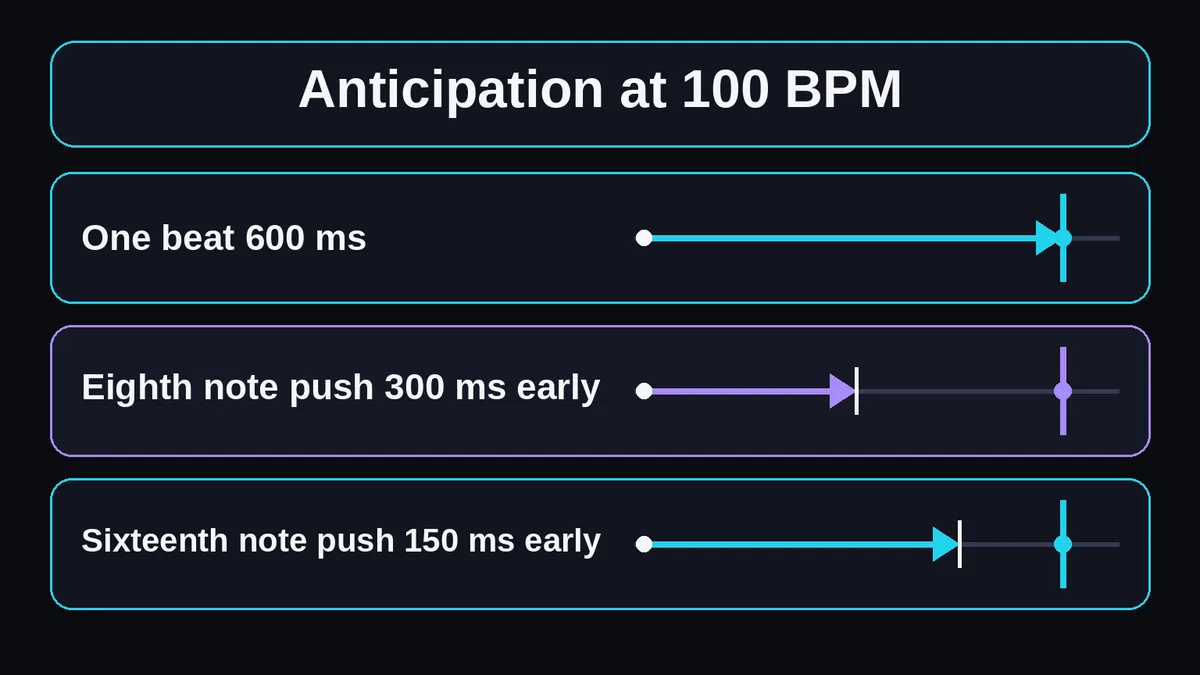
An eighth note anticipation arrives half a beat early; a sixteenth note anticipation arrives a quarter of a beat early. At 100 BPM that is 300 milliseconds and 150 milliseconds. The faster the tempo, the smaller the gap, which is why fast syncopation feels so tight.
| Tempo | One beat | Eighth note push | Sixteenth note push |
|---|---|---|---|
| 80 BPM | 750 ms | 375 ms | 187.5 ms |
| 100 BPM | 600 ms | 300 ms | 150 ms |
| 120 BPM | 500 ms | 250 ms | 125 ms |
| 140 BPM | 428.57 ms | 214.29 ms | 107.14 ms |
Producers placing notes in a DAW grid use exactly these numbers. Moving a chord one sixteenth earlier at 120 BPM shifts it by 125 ms, enough to change a stiff loop into one that leans forward. The BPM to milliseconds converter gives the values for any tempo.
Where Do You Hear Syncopation?
Syncopation is everywhere, from medieval songs to modern dance music. Wikipedia notes its use since at least the Middle Ages and lists it across ragtime, rock and rap, while one producer it quotes says all dance music makes use of it. A few landmarks show how differently it can sound.
- Ragtime. Scott Joplin's Maple Leaf Rag sets a syncopated right hand melody against an even, oom pah left hand. The steady bass is the grid; the melody keeps landing between its beats.
- Beethoven, Symphony No. 3, the Eroica. Wikipedia points to its loud chords on weak beats, accents off the beat and rests where strong beats are expected, all within the first movement.
- Handel, Water Music, Hornpipe. Insistent off beat accents give the dance its confident swagger.
- The Rolling Stones, "(I Can't Get No) Satisfaction." Wikipedia cites its riff as a clear example, built from a simple figure shifted onto the backbeat and slightly before the beat.
- Funk, reggae and Latin music. Funk uses sixteenth note pushes, reggae stresses the off beats, and Latin styles build on patterns such as the tresillo and the clave.
How Is Syncopation Different From Swing and Polyrhythm?
Syncopation moves the accent within a regular grid. Swing changes the grid itself by making paired eighth notes uneven. Polyrhythm layers two different grids at once, such as three against two. A swung rhythm can be syncopated, but the two ideas are separate.
| Idea | What changes | Example |
|---|---|---|
| Syncopation | Where the accent falls | A push on the "and" of 4 |
| Swing | How each beat is divided | Long short eighth note pairs in jazz |
| Polyrhythm | How many grids play together | Three even notes against two |
| Hemiola | How beats are grouped across bars | Two bars of 3/4 felt as three bars of 2 |
Keeping these apart helps when you practice. If a rhythm feels wrong, ask whether the notes are misplaced (syncopation), unevenly spaced (swing), or following a second pulse (polyrhythm). Each problem has a different fix.
How Do You Practice Syncopation With a Metronome?
Use the metronome as the unbroken grid and put every syncopated note against it. Set the online metronome to a slow tempo such as 70 BPM with eighth note subdivision, so you can hear exactly where each "and" falls before you try to play on it.
- Clap on every eighth note click for two bars, saying "1 and 2 and." This locks in the grid.
- Clap only the "and" clicks for four bars. Keep saying the numbers out loud so the beat does not drift onto your claps.
- Clap the push pattern from the table above: hold through beat 3 without clapping it. Tap your foot on every beat.
- Turn the subdivision off and play the same pattern against quarter note clicks only. Now the "ands" have no click, which is the real skill.
- Raise the tempo with the speed trainer by 2 BPM every 8 bars. Stop when the off beats start drifting back onto the beat.
For call and response drills, the rhythm trainer is a good next step. To find the tempo of a syncopated recording, tap the steady beat on the tap tempo tool, not the accents; tapping the accents gives an uneven, misleading reading.